
Zigzags and central circuits
We have considered the structure of central circuit (circuit of edges, such that no two consecutive edges belong to the same face) for 4-valent plane graph and zigzags (circuit of edges, such that any two, but no three, consecutive edges belong to the same face) for 3-valent plane graphs. See below two parts of such objects:
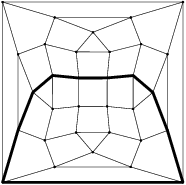
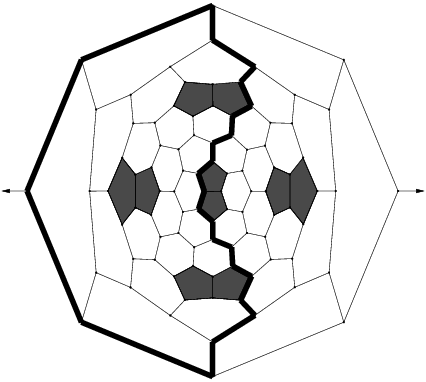
Those notions were considered for 3- or 4-valent maps, whose faces have size at most 6 or 4, respectively. We classified the graphs, which are 2-connected but not 3-connected and we give all possible symmetry groups. The invention of railroads, which roughly speaking is two parallel such objects, allowed us to introduce new notions and extremal problems, which led to several classification results.
The Goldberg-Coxeter construction, which takes a 3- or 4-valent plane graph and a pair (k,l) of integers for creating a new 3- or 4-valent plane maps was considered in this context: We computed the zigzag or central circuit structure of the Goldberg construction by creating a new formalism of (k,l)-product and the introduction of a finite index subgroup of SL2(Z).
L M. Dutour, M. Deza, Goldberg-Coxeter construction for 3- or 4-valent plane graphs, Electronic Journal of Combinatorics 11 (2004) R20.
L M. Deza, M. Dutour, Zigzag Structure of Simple Two-faced Polyhedra, Combin. Probab. Comput. 14 (2005), 31--57
L M. Deza, M. Dutour, P. Fowler, Zigzags, Railroads, and Knots in Fullerenes, Journal of Chemical Information and Computer Sciences 44 (2004) 1282--1293.
L M. Deza, M. Dutour, M. Shtogrin, 4-valent plane graphs with 2-, 3- and 4-gonal faces, "Advances in Algebra and Related Topics", World Scientific Publ. Co. (2003) 73--97.