
Elementary polycycles and Face regular maps
We classified elementary elliptic (R,q)-polycycles to create an efficient enumeration technique. This method was successfully applied to the classification and study of face-regular spheres and tori.
A (R,q)-polycycle is, roughly, a piece of a plane graph whose faces are i-gons with i in a set R, and whose vertices have degree q, except on the boundary of some holes. A typical example is a patch of a fullerene made only of pentagons. The polycycle is called elliptic, parabolic or hyperbolic if 1/q + 1/r − 1/2 is positive, zero or negative, where r is the largest element of R. Elliptic polycycles are those of positive curvature: there are few of them, and they are the pieces that make a surface close up into a sphere.
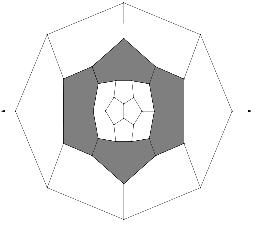
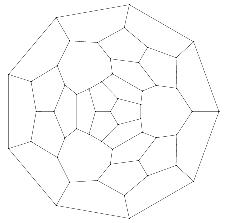
Polycycles can be glued along their boundaries. An edge of a hole is open if both its end vertices have degree less than q, and a polycycle is elementary if it cannot be cut into smaller polycycles along open edges. Every polycycle is then obtained in a unique way by gluing elementary ones. With Michel Deza and Mikhail Shtogrin, we enumerated all elliptic elementary polycycles, that is the elementary ({2,3,4,5},3)-, ({2,3},4)- and ({2,3},5)-polycycles. They consist of finitely many sporadic examples and a few infinite series.
This list turns the study of a plane graph into a puzzle with known pieces. Take a 3-valent sphere whose faces are pentagons and q-gons, and look at the subgraph formed by its pentagons. It is a (5,3)-polycycle, so it is obtained by gluing elementary pieces from the list. The possible arrangements of the pentagons are then found by hand or by computer.
We applied this method to face-regular maps. A 3-valent map on the sphere or the torus with p-gonal and q-gonal faces is called pRi if every p-gonal face is adjacent to exactly i p-gonal faces, and qRj is defined in the same way. These classes include many structures studied by chemists, such as fullerenes in which the pentagons are isolated. For each class, we determined whether it is empty, finite or infinite, and gave the complete list when it is finite. The figures above show two such spheres: a (5,8)-sphere 8R2 and a (5,9)-sphere 9R0. This work forms a large part of the book Geometry of Chemical Graphs with Michel Deza.
M. Deza, M. Dutour Sikirić, M. Shtogrin, Elementary elliptic (R,q)-polycycles, in Analysis of Complex Networks, Wiley-Blackwell (2009) 351–376.
M. Deza, M. Dutour Sikirić, Geometry of Chemical Graphs: Polycycles and Two-faced Maps, Cambridge University Press, Encyclopedia of Mathematics and its Applications 119 (2008).