
Iso-Delaunay domains and the lattice covering problem
Using semidefinite programming, we optimized covering densities over iso-Delaunay domains. This allowed us to find record lattice coverings in dimensions 9 through 15 and classify thin algebraic number fields.
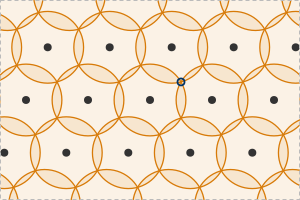
The covering problem is the opposite of the packing problem. We cover space with balls of equal radius, so that every point lies in at least one ball, and want the thinnest covering, the one where points are covered as few times as possible on average. For lattice coverings, the radius needed is the covering radius of the lattice, which is the largest radius of its empty spheres. The problem is solved in dimension 2 and 3, and the best lattice covering is the lattice An* up to dimension 5. In higher dimensions only records are known.
Voronoi's second reduction theory gives the structure of the problem. The space of positive definite quadratic forms, that is of lattices up to isometry, is divided into polyhedral cones called iso-Delaunay domains. All the lattices of one domain have the same Delaunay tessellation. Inside one iso-Delaunay domain, the covering density can be computed from the Delaunay polytopes, and minimizing it is a convex problem that can be solved by semidefinite programming. If all iso-Delaunay domains are known, solving each of these problems solves the lattice covering problem. In practice the number of domains explodes, and this works only up to dimension 5.
With Achill Schürmann and Frank Vallentin, we extended Voronoi's theory to quadratic forms in a linear subspace of the space of all forms, for example the forms that have a prescribed symmetry group. In such a subspace there are much fewer iso-Delaunay domains, and the theory can be applied in much higher dimensions. Searching in suitable subspaces, we found new best known lattice coverings in all dimensions from 9 to 15.
The same theory applied to number theory: the subspaces given by totally real number fields allowed us to complete the classification of the totally real thin algebraic number fields, started by Bayer-Fluckiger and Nebe.
Related work continues today. With Sven Ahrend, we found a periodic point set that is not a lattice and beats the best lattice for the packing-covering constant in dimension five.
A. Schürmann, M. Dutour Sikirić, F. Vallentin, A generalization of Voronoi's reduction theory and its application, Duke Math. J. 142 (2008) 127–164.
S. Ahrend, M. Dutour Sikirić, A non-lattice periodic point set beating the optimal lattice packing-covering constant in dimension five, arXiv:2609.30513.