
Cube packings and tilings
We investigated periodic cube packings and tilings in Rn, proving extensibility theorems for dense packings. Our research provides lower bounds on non-extendible packings and explores their continuous parametrization.
Consider packings of Rd by translates of the cube [0,2[d placed at integer positions, and periodic under the lattice 4Zd. Equivalently, we pack cubes of side 2 in a torus of side 4, which has room for exactly 2d cubes. When all 2d cubes are present, the packing is a tiling. Such tilings are much more varied than the regular one, since layers can slide against each other. They are closely related to Keller's conjecture, which says that every tiling of space by unit cubes has two cubes that share a full face, true in low dimensions and false in high dimensions.
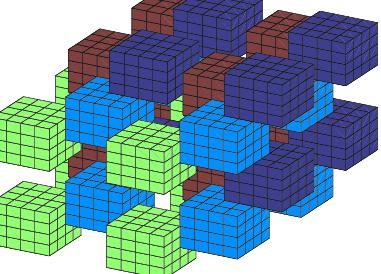
A packing is non-extendible if no cube can be added to it, although it is not a tiling. Such packings exist: in dimension 3 there is a unique non-extendible packing with 4 cubes, half of the 8 that a tiling would have. With Yoshiaki Itoh and Alexei Poyarkov, we described cube packings by the cliques of an associated graph. This allowed us to classify them completely in dimension d ≤ 4 and to generate random examples in higher dimension. We proved that a packing with more than 2d − 3 cubes can always be extended to a tiling, and we gave a lower bound on the number of cubes of a non-extendible packing. We also studied the second moment, the average of the square of the number of cubes in a window of side 4, and proved that the regular tiling maximizes it.
This research grew out of the study of random sequential packing: put cubes one after another at random positions, as long as there is room. In one dimension this is Rényi's parking problem. In the discrete setting the result is always a non-extendible packing, and the question is how many cubes one expects. With Yoshiaki Itoh we also considered the continuous version, where the cubes can be placed at any real position. Surprisingly, it is still amenable to combinatorial methods: the packings are organized into finitely many combinatorial types, each with a continuous parametrization.
This work is collected in the book Random Sequential Packing of Cubes (World Scientific, 2011) with Yoshiaki Itoh. It was later continued with a study of the two-periodic cube tilings of R4 with Magdalena Łysakowska.
M. Dutour Sikirić, Y. Itoh, A. Poyarkov, Cube packings, second moment and holes, European J. Combin. 28 (2007) 715–725.
M. Dutour Sikirić, Y. Itoh, Combinatorial cube packings in the cube and the torus, European J. Combin. 31 (2010) 517–534.