
Simplicial complexes
All simplicial n-complexes with specific face containment properties have been classified. This work provides a classification based on the partitions of set elements related to the dimension of the complex.
A closed simplicial n-complex is built by gluing n-dimensional simplices along their faces. One way to measure its local shape is the link of its (n−2)-dimensional faces. In a triangulated surface (n = 2), the (n−2)-faces are the vertices, and the link of a vertex is the cycle of triangles around it; its length is the degree of the vertex. Large links mean negative curvature, short links mean strong positive curvature.
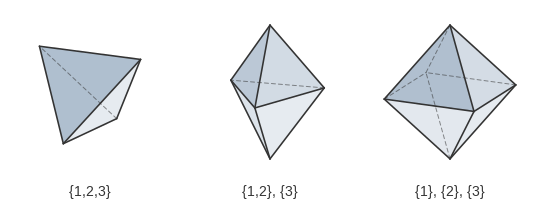
With Michel Deza and Mikhail Shtogrin, we studied the extreme case of short links, where every (n−2)-face lies in only 3 or 4 n-simplices. One expects such a strong condition to leave few possibilities, and indeed the complexes are completely classified. Each of them is determined by its characteristic partition, a partition of the set {1, …, n+1}. A part with k elements corresponds to the boundary of a k-dimensional simplex, and the complex is the join of these boundaries.
For surfaces, the three partitions of {1,2,3} give the three triangulations of the sphere whose vertices all have degree 3 or 4:
- {1,2,3}: the tetrahedron, with all vertices of degree 3;
- {1,2}, {3}: the triangular bipyramid, with two vertices of degree 3 and three of degree 4;
- {1}, {2}, {3}: the octahedron, with all vertices of degree 4.
In higher dimensions the same rule produces, for example, the boundary of the (n+1)-simplex and the boundary of the cross-polytope, at the two ends of the list.
The same paper considers cubical complexes with short links, and the embedding of the skeletons of these complexes into hypercubes. This is one of several works with Michel Deza on the L1-embedding of graphs coming from geometry, of which the Wythoff polytopes are another example.
M. Deza, M. Dutour Sikirić, M. Shtogrin, On simplicial and cubical complexes with short links, Israel J. Math. 144 (2004) 109–124.