
Ginzburg Landau model
I established the phase diagram for the bulk Ginzburg-Landau model of superconductivity using complex hermitian geometry. This included establishing the Abrikosov asymptotic expansion for minimal energy states.
The Ginzburg–Landau model describes a superconductor by two unknowns: a complex wave function φ, whose modulus |φ|2 is the density of superconducting electrons, and the magnetic field inside the material. The state of the material minimizes an energy that depends on two parameters, the exterior magnetic field Hext and a structural constant κ of the material. My PhD thesis studied the bulk version of the model, in which the material fills the whole space and the states are periodic with respect to a lattice.
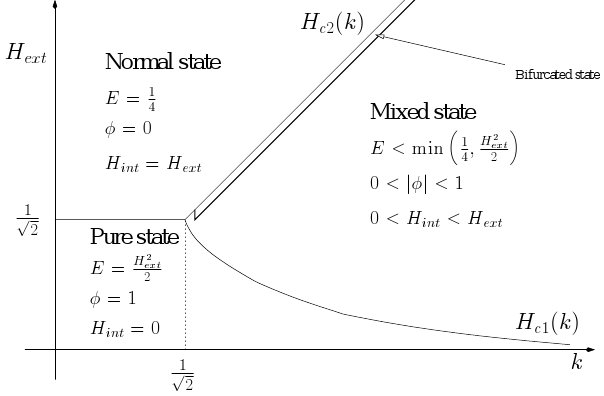
Three kinds of states appear. In the pure state |φ| = 1, the material is superconducting everywhere and expels the magnetic field. In the normal state φ = 0, superconductivity is destroyed and the field goes through the material. In the mixed state both coexist: the field enters along vortex lines, around which φ vanishes, and these vortices arrange themselves in a periodic lattice. This is the Abrikosov lattice, predicted by Abrikosov in 1957 and observed later in type II superconductors.
The first result is the phase diagram: for every value of (κ, Hext), which of the three states has the lowest energy. The physicists' picture had been obtained by formal arguments, and my thesis proved its classical form. The main tool comes from complex geometry. When the energy is written on the torus defined by the lattice, the wave function becomes a section of a line bundle, and the Bochner–Kodaira–Nakano formula gives the estimates that separate the regions of the diagram.
The second result concerns the transition from the normal state to the mixed state. Near the critical field the solutions bifurcate from φ = 0, and the minimal energy and the minimizing states have an asymptotic expansion, first computed formally by Abrikosov. I proved this expansion. The leading term is given by the lowest Landau level, a space of holomorphic sections described by theta functions, and the choice of the vortex lattice comes from the minimization of a quantity of the form ⟨|φ|4⟩ / ⟨|φ|2⟩2 over this space.
M. Dutour, Phase diagram for Abrikosov lattice, J. Math. Phys. 42 (2001) 4915–4926.
M. Dutour, A result on the phase diagram of a Ginzburg-Landau problem, HAIT J. Sci. Eng. 1 (2004) 23–40.